Artificial Intelligence

In computer science, Artificial Intelligence (AI), sometimes called
machine
intelligence,
is intelligence
demonstrated by machines, in contrast to the natural intelligence displayed by humans. Leading AI
textbooks
define the field as the study of "intelligent agents": any device that perceives its environment and
takes
actions that maximize its chance of successfully achieving its goals. Colloquially, the term "artificial
intelligence" is often used to describe machines (or computers) that mimic "cognitive" functions that
humans
associate with the human mind, such as "learning" and "problem solving".
As machines become increasingly capable, tasks considered to require "intelligence" are often removed
from
the
definition of AI, a phenomenon known as the AI effect. A quip in Tesler's Theorem says "AI is whatever
hasn't
been done yet." For instance, optical character recognition is frequently excluded from things
considered to
be AI, having become a routine technology. Modern machine capabilities generally classified as AI
include
successfully understanding human speech, competing at the highest level in strategic game systems (such
as
chess and Go), autonomously operating cars, intelligent routing in content delivery networks, and
military
simulations.
Artificial intelligence was founded as an academic discipline in 1956, and in the years since has
experienced
several waves of optimism, followed by disappointment and the loss of funding (known as an "AI
winter"), followed by new approaches, success and renewed funding. For most of its history, AI
research has been divided into subfields that often fail to communicate with each other. These
sub-fields
are based on technical considerations, such as particular goals (e.g. "robotics" or "machine
learning"),the
use of particular tools ("logic" or artificial neural networks), or deep philosophical differences.
Subfields have also been based on social factors (particular institutions or the work of particular
researchers).
The traditional problems (or goals) of AI research include reasoning, knowledge representation,
planning,
learning, natural language processing, perception and the ability to move and manipulate objects.
General
intelligence is among the field's long-term goals. Approaches include statistical methods, computational
intelligence, and traditional symbolic AI. Many tools are used in AI, including versions of search and
mathematical optimization, artificial neural networks, and methods based on statistics, probability and
economics. The AI field draws upon computer science, information engineering, mathematics, psychology,
linguistics, philosophy, and many other fields.
The field was founded on the assumption that human intelligence "can be so precisely described that a
machine
can be made to simulate it". This raises philosophical arguments about the nature of the mind and the
ethics
of creating artificial beings endowed with human-like intelligence. These issues have been explored by
myth,
fiction and philosophy since antiquity. Some people also consider AI to be a danger to humanity if it
progresses unabated. Others believe that AI, unlike previous technological revolutions, will create a
risk
of mass unemployment.
In the twenty-first century, AI techniques have experienced a resurgence following concurrent advances
in
computer power, large amounts of data, and theoretical understanding; and AI techniques have become an
essential
part of the technology industry, helping to solve many challenging problems in computer science,
software
engineering and operations research.
Types of artificial intelligence
Arend Hintze, an assistant professor of integrative biology and computer science and
engineering at Michigan State University, categorizes AI into four types, from the kind of AI systems
that exist today to sentient systems, which do not yet exist. His categories are as follows:
-
Type 1: Reactive machines. An example is Deep Blue, the
IBM
chess program that beat
Garry Kasparov in the 1990s. Deep Blue can identify pieces on the chess board and make predictions, but
it has no memory and cannot use past experiences to inform future ones. It analyzes possible moves --
its own and its opponent -- and chooses the most strategic move. Deep Blue and Google's
AlphaGO were
designed for narrow purposes and cannot easily be applied to another situation.
-
Type 2: Limited memory.These AI systems can use past experiences to inform
future
decisions. Some of the decision-making functions in self-driving cars are designed this way.
Observations inform actions happening in the not-so-distant future, such as a car changing lanes. These
observations are not stored permanently.
- Type 3: Theory of mind.
This psychology term refers to the understanding that others
have their own beliefs, desires and intentions that impact the decisions they make. This kind of AI does
not yet exist.
Type 4: Self-awareness.In this category, AI systems have a sense of self,
have
consciousness. Machines with self-awareness understand their current state and can use the information
to infer what others are feeling. This type of AI does not yet exist .
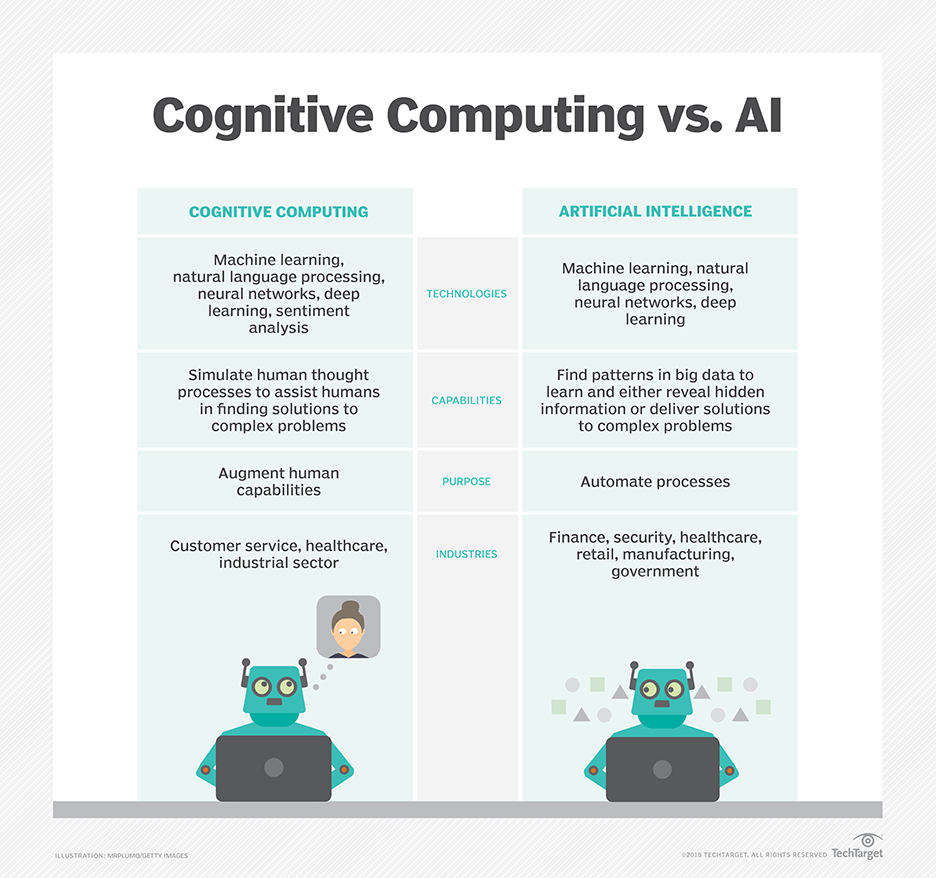 what is the difference between AI and congnitive computing ?
Example of AI technology
AI is incorporated into a variety of different types of technology. Here are seven examples.
-
Automation : What makes a system or process function automatically. For
example,(RPA) can be programmed to perform high-volume, repeatable tasks that humans
normally performed. RPA is different from IT automation in that it can adapt to changing circumstances.
-
Machine learning: The science of getting a computer to act without
programming . Deep
learning
is a subset of machine learning that, in very simple terms, can be thought of as the automation of
predictive analytics. There are three types of machine learning algorithms:
-
supervised learning: Data sets are labeled so that patterns can
be detected and used to label new data sets
-
Unsupervised learning:
Data sets aren't labeled and are sorted according to similarities or
differences
-
Reinforcement learning:
Data sets aren't labeled but, after performing an action or several actions, the AI
system is given feedback
-
Machine vision: The science of allowing computers to see. This technology
captures and
analyzes visual information using a camera, analog-to-digital conversion and digital signal processing.
It is often compared to human eyesight, but machine vision isn't bound by biology and can be programmed
to see through walls, for example. It is used in a range of applications from signature identification
to medical image analysis. Computer vision, which is focused on machine-based image processing, is often
conflated with machine vision.
-
Natural language processing (NLP): The processing of human -- and not
computer --
language by a computer program. One of the older and best known examples of NLP is spam detection, which
looks at the subject line and the text of an email and decides if it's junk. Current approaches to NLP
are based on machine learning. NLP tasks include text translation, sentiment analysis and speech
recognition.
-
Self-driving cars: These use a combination of computer vision, image
recognition and
deep learning to build automated skill at piloting a vehicle while staying in a given lane and avoiding
unexpected obstructions, such as pedestrians.
WHY RESEARCH AI SAFETY?
In the near term, the goal of keeping AI’s impact on society beneficial motivates research in many areas,
from economics and law to technical topics such as verification, validity, security and control. Whereas it
may be little more than a minor nuisance if your laptop crashes or gets hacked, it becomes all the more
important that an AI system does what you want it to do if it controls your car, your airplane, your
pacemaker, your automated trading system or your power grid. Another short-term challenge is preventing a
devastating arms race in lethal autonomous weapons.
In the long term, an important question is what will happen if the quest for strong AI succeeds and an AI
system becomes better than humans at all cognitive tasks. As pointed out by I.J. Good in 1965, designing
smarter AI systems is itself a cognitive task. Such a system could potentially undergo recursive
self-improvement, triggering an intelligence explosion leaving human intellect far behind. By inventing
revolutionary new technologies, such a superintelligence might help us eradicate war, disease, and poverty,
and so the creation of strong AI might be the biggest event in human history. Some experts have expressed
concern, though, that it might also be the last, unless we learn to align the goals of the AI with ours
before it becomes superintelligent.
There are some who question whether strong AI will ever be achieved, and others who insist that the creation
of superintelligent AI is guaranteed to be beneficial. At FLI we recognize both of these possibilities, but
also recognize the potential for an artificial intelligence system to intentionally or unintentionally cause
great harm. We believe research today will help us better prepare for and prevent such potentially negative
consequences in the future, thus enjoying the benefits of AI while avoiding pitfalls.
HOW CAN AI BE DANGEROUS?
Most researchers agree that a superintelligent AI is unlikely to exhibit human emotions like love or hate,
and that there is no reason to expect AI to become intentionally benevolent or malevolent. Instead, when
considering how AI might become a risk, experts think two scenarios most likely:
-
The AI is programmed to do something devastating: Autonomous weapons are
artificial
intelligence systems that are programmed to kill. In the hands of the wrong person, these weapons could
easily cause mass casualties. Moreover, an AI arms race could inadvertently lead to an AI war that also
results in mass casualties. To avoid being thwarted by the enemy, these weapons would be designed to be
extremely difficult to simply “turn off,” so humans could plausibly lose control of such a situation. This
risk is one that’s present even with narrow AI, but grows as levels of AI intelligence and autonomy
increase.
-
The AI is programmed to do something beneficial, but it develops a destructive method for achieving
its
goal:
This can happen whenever we fail to fully align the AI’s goals with ours, which is
strikingly
difficult. If you ask an obedient intelligent car to take you to the airport as fast as possible, it might
get you there chased by helicopters and covered in vomit, doing not what you wanted but literally what you
asked for. If a superintelligent system is tasked with a ambitious geoengineering project, it might wreak
havoc with our ecosystem as a side effect, and view human attempts to stop it as a threat to be met.
As these examples illustrate, the concern about advanced AI isn’t malevolence but competence. A
super-intelligent AI will be extremely good at accomplishing its goals, and if those goals aren’t aligned with
ours, we have a problem. You’re probably not an evil ant-hater who steps on ants out of malice, but if you’re in
charge of a hydroelectric green energy project and there’s an anthill in the region to be flooded, too bad for
the ants. A key goal of AI safety research is to never place humanity in the position of those ants.
WHY THE RECENT INTEREST IN AI SAFETY
Stephen Hawking, Elon Musk, Steve Wozniak, Bill Gates, and many other big names in science and
technology have recently expressed concern in the media and via open letters about the risks posed by
AI, joined by many leading AI researchers. Why is the subject suddenly in the headlines?
The idea that the quest for strong AI would ultimately succeed was long thought of as science fiction,
centuries or more away. However, thanks to recent breakthroughs, many AI milestones, which experts
viewed as decades away merely five years ago, have now been reached, making many experts take seriously
the possibility of superintelligence in our lifetime. While some experts still guess that human-level AI
is centuries away, most AI researches at the 2015 Puerto Rico Conference guessed that it would happen
before 2060. Since it may take decades to complete the required safety research, it is prudent to start
it now.
Because AI has the potential to become more intelligent than any human, we have no surefire way of
predicting how it will behave. We can’t use past technological developments as much of a basis because
we’ve never created anything that has the ability to, wittingly or unwittingly, outsmart us. The best
example of what we could face may be our own evolution. People now control the planet, not because we’re
the strongest, fastest or biggest, but because we’re the smartest. If we’re no longer the smartest, are
we assured to remain in control?
FLI’s position is that our civilization will flourish as long as we win the race between the growing
power of technology and the wisdom with which we manage it. In the case of AI technology, FLI’s position
is that the best way to win that race is not to impede the former, but to accelerate the latter, by
supporting AI safety research.
THE TOP MYTHS ABOUT ADVANCED AI
A captivating conversation is taking place about the future of artificial intelligence and what it
will/should mean for humanity. There are fascinating controversies where the world’s leading experts
disagree, such as: AI’s future impact on the job market; if/when human-level AI will be developed;
whether this will lead to an intelligence explosion; and whether this is something we should welcome or
fear. But there are also many examples of of boring pseudo-controversies caused by people
misunderstanding and talking past each other. To help ourselves focus on the interesting controversies
and open questions — and not on the misunderstandings — let’s clear up some of the most common myths.
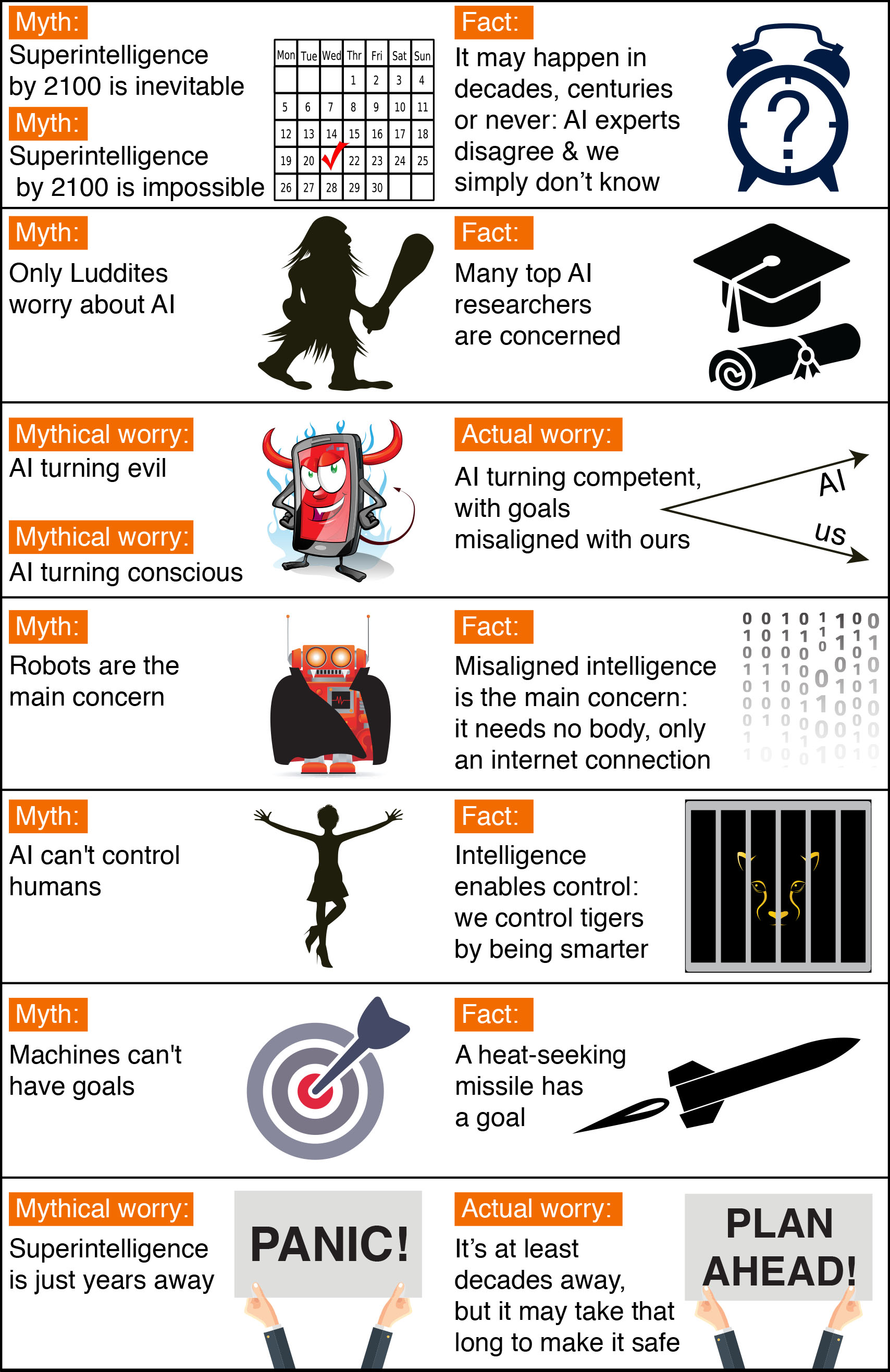 [Image source Internet]
TIMELINE MYTHS
The first myth regards the timeline: how long will it take until machines greatly supersede
human-level
intelligence? A common misconception is that we know the answer with great certainty.
One popular myth is that we know we’ll get superhuman AI this century. In fact, history is full of
technological over-hyping. Where are those fusion power plants and flying cars we were promised we’d
have by now? AI has also been repeatedly over-hyped in the past, even by some of the founders of the
field. For example, John McCarthy (who coined the term “artificial intelligence”), Marvin Minsky,
Nathaniel Rochester and Claude Shannon wrote this overly optimistic forecast about what could be
accomplished during two months with stone-age computers: “We propose that a 2 month, 10 man study of
artificial intelligence be carried out during the summer of 1956 at Dartmouth College […] An attempt
will be made to find how to make machines use language, form abstractions and concepts, solve kinds
of
problems now reserved for humans, and improve themselves. We think that a significant advance can be
made in one or more of these problems if a carefully selected group of scientists work on it
together
for a summer.”
On the other hand, a popular counter-myth is that we know we won’t get superhuman AI this century.
Researchers have made a wide range of estimates for how far we are from superhuman AI, but we
certainly
can’t say with great confidence that the probability is zero this century, given the dismal track
record
of such techno-skeptic predictions. For example, Ernest Rutherford, arguably the greatest nuclear
physicist of his time, said in 1933 — less than 24 hours before Szilard’s invention of the nuclear
chain
reaction — that nuclear energy was “moonshine.” And Astronomer Royal Richard Woolley called
interplanetary travel “utter bilge” in 1956. The most extreme form of this myth is that superhuman
AI
will never arrive because it’s physically impossible. However, physicists know that a brain consists
of
quarks and electrons arranged to act as a powerful computer, and that there’s no law of physics
preventing us from building even more intelligent quark blobs.
There have been a number of surveys asking AI researchers how many years from now they think we’ll
have
human-level AI with at least 50% probability. All these surveys have the same conclusion: the
world’s
leading experts disagree, so we simply don’t know. For example, in such a poll of the AI researchers
at
the 2015 Puerto Rico AI conference, the average (median) answer was by year 2045, but some
researchers
guessed hundreds of years or more.
There’s also a related myth that people who worry about AI think it’s only a few years away. In
fact,
most people on record worrying about superhuman AI guess it’s still at least decades away. But they
argue that as long as we’re not 100% sure that it won’t happen this century, it’s smart to start
safety
research now to prepare for the eventuality. Many of the safety problems associated with human-level
AI
are so hard that they may take decades to solve. So it’s prudent to start researching them now
rather
than the night before some programmers drinking Red Bull decide to switch one on.
CONTROVERSY MYTHS
Another common misconception is that the only people harboring concerns about AI and advocating AI
safety research are luddites who don’t know much about AI. When Stuart Russell, author of the standard
AI textbook, mentioned this during his Puerto Rico talk, the audience laughed loudly. A related
misconception is that supporting AI safety research is hugely controversial. In fact, to support a
modest investment in AI safety research, people don’t need to be convinced that risks are high, merely
non-negligible — just as a modest investment in home insurance is justified by a non-negligible
probability of the home burning down.
It may be that media have made the AI safety debate seem more controversial than it really is. After
all, fear sells, and articles using out-of-context quotes to proclaim imminent doom can generate more
clicks than nuanced and balanced ones. As a result, two people who only know about each other’s
positions from media quotes are likely to think they disagree more than they really do. For example, a
techno-skeptic who only read about Bill Gates’s position in a British tabloid may mistakenly think Gates
believes superintelligence to be imminent. Similarly, someone in the beneficial-AI movement who knows
nothing about Andrew Ng’s position except his quote about overpopulation on Mars may mistakenly think he
doesn’t care about AI safety, whereas in fact, he does. The crux is simply that because Ng’s timeline
estimates are longer, he naturally tends to prioritize short-term AI challenges over long-term ones.
MYTHS ABOUT THE RISKS OF SUPERHUMAN AI
Many AI researchers roll their eyes when seeing this headline: “Stephen Hawking warns that rise of
robots may be disastrous for mankind.” And as many have lost count of how many similar articles
they’ve
seen. Typically, these articles are accompanied by an evil-looking robot carrying a weapon, and they
suggest we should worry about robots rising up and killing us because they’ve become conscious and/or
evil. On a lighter note, such articles are actually rather impressive, because they succinctly summarize
the scenario that AI researchers don’t worry about. That scenario combines as many as three separate
misconceptions: concern about consciousness, evil, and robots.
If you drive down the road, you have a subjective experience of colors, sounds, etc. But does a
self-driving car have a subjective experience? Does it feel like anything at all to be a self-driving
car? Although this mystery of consciousness is interesting in its own right, it’s irrelevant to AI risk.
If you get struck by a driverless car, it makes no difference to you whether it subjectively feels
conscious. In the same way, what will affect us humans is what superintelligent AI does, not how it
subjectively feels.
The fear of machines turning evil is another red herring. The real worry isn’t malevolence, but
competence. A superintelligent AI is by definition very good at attaining its goals, whatever they may
be, so we need to ensure that its goals are aligned with ours. Humans don’t generally hate ants, but
we’re more intelligent than they are – so if we want to build a hydroelectric dam and there’s an anthill
there, too bad for the ants. The beneficial-AI movement wants to avoid placing humanity in the position
of those ants.
The consciousness misconception is related to the myth that machines can’t have goals. Machines can
obviously have goals in the narrow sense of exhibiting goal-oriented behavior: the behavior of a
heat-seeking missile is most economically explained as a goal to hit a target. If you feel threatened by
a machine whose goals are misaligned with yours, then it is precisely its goals in this narrow sense
that troubles you, not whether the machine is conscious and experiences a sense of purpose. If that
heat-seeking missile werechasing you, you probably wouldn’t exclaim: “I’m not worried, because
machines
can’t have goals!”
I sympathize with Rodney Brooks and other robotics pioneers who feel unfairly demonized by
scaremongering tabloids, because some journalists seem obsessively fixated on robots and adorn many of
their articles with evil-looking metal monsters with red shiny eyes. In fact, the main concern of the
beneficial-AI movement isn’t with robots but with intelligence itself: specifically, intelligence whose
goals are misaligned with ours. To cause us trouble, such misaligned superhuman intelligence needs no
robotic body, merely an internet connection – this may enable outsmarting financial markets,
out-inventing human researchers, out-manipulating human leaders, and developing weapons we cannot even
understand. Even if building robots were physically impossible, a super-intelligent and super-wealthy AI
could easily pay or manipulate many humans to unwittingly do its bidding.
The robot misconception is related to the myth that machines can’t control humans. Intelligence enables
control: humans control tigers not because we are stronger, but because we are smarter. This means that
if we cede our position as smartest on our planet, it’s possible that we might also cede control.
How Artificial Intelligence Is Being Used
"Every industry has a high demand for AI capabilities – especially question answering systems
that
can be used for legal assistance, patent searches, risk notification and medical research. Other uses of
AI
include:"
Health Care
AI applications can provide personalized medicine and X-ray readings. Personal health care
assistants can act as life coaches, reminding you to take your pills, exercise or eat healthier.
Retail
AI provides virtual shopping capabilities that offer personalized recommendations and discuss
purchase options with the consumer. Stock management and site layout technologies will also be
improved with AI.
Manufacturing
AI can analyze factory IoT data as it streams from connected equipment to forecast expected load
and demand using recurrent networks, a specific type of deep learning network used with sequence
data.
Banking
Artificial Intelligence enhances the speed, precision and effectiveness of human efforts. In
financial institutions, AI techniques can be used to identify which transactions are likely to
be fraudulent, adopt fast and accurate credit scoring, as well as automate manually intense data
management tasks.
Working together with AI
Artificial intelligence is not here to replace us. It augments our abilities and makes us better
at what we do. Because AI algorithms learn differently than humans, they look at things
differently. They can see relationships and patterns that escape us. This human, AI partnership
offers many opportunities. It can:
- Bring analytics
to industries and domains where it’s currently underutilized.
- Improve the performance of existing analytic technologies, like computer vision and time
series analysis.
- Break down economic barriers, including language and translation barriers.
- Augment existing abilities and make us better at what we do.
- Give us better vision, better understanding, better memory and much more.
<
></>
What are the challenges of using artificial intelligence?
Artificial intelligence is going to change every industry, but we have to understand its limits.
The principle limitation of AI is that it learns from the data. There is no other way in which knowledge can
be incorporated. That means any inaccuracies in the data will be reflected in the results. And any
additional layers of prediction or analysis have to be added separately.
Today’s AI systems are trained to do a clearly defined task. The system that plays poker cannot play
solitaire or chess. The system that detects fraud cannot drive a car or give you legal advice. In fact, an
AI system that detects health care fraud cannot accurately detect tax fraud or warranty claims fraud.
In other words, these systems are very, very specialized. They are focused on a single task and are far from
behaving like humans.
Likewise, self-learning systems are not autonomous systems. The imagined AI technologies that you see in
movies and TV are still science fiction. But computers that can probe complex data to learn and perfect
specific tasks are becoming quite common.
Comments
Post a Comment